Intellectual Property Office - Patents Journal : UK applications published
GB0820637.7
Patente:
GB2465213
GB0820637.7
Patente:
GB2465213
Excerto do texto da patente:
«As means of introducing the key aspects covered by this invention consider Microsoft Corporation’s computer-based puzzle game Tetravex and the mathematical work of Jorge Rezende, University of Lisbon.(...)The mathematical work of Jorge Rezende has been published in the papers entitled “On the Puzzles with Polyhedra and Numbers” and “Puzzles with Polyhedra and Permutation Groups”, available via the web site of the Mathematical Group of the University of Lisbon
«As means of introducing the key aspects covered by this invention consider Microsoft Corporation’s computer-based puzzle game Tetravex and the mathematical work of Jorge Rezende, University of Lisbon.(...)The mathematical work of Jorge Rezende has been published in the papers entitled “On the Puzzles with Polyhedra and Numbers” and “Puzzles with Polyhedra and Permutation Groups”, available via the web site of the Mathematical Group of the University of Lisbon
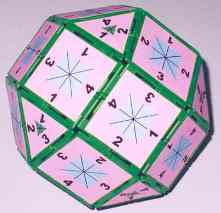
The publications cover the mathematical methods behind using polygonal plates (tiles), with numerical indicia ascríbed to each edge, to form the surface of regular polyhedron. Although the analysis is very detailed and covers a method (effectively a search based routine) that determines how many solutions a particular indicia set can produce, i.e. how many different ways the tiles can be arranged to form the surface of the polyhedron by matching adjacent indicia of different tiles, there is no discussion on limiting the allocation of the indicia to ensure an unique solution.»
See also:
espacenet
See also:
espacenet
Aqui: espacenet





.jpg)
.jpg)
.jpg)


.jpg)
.jpg)