Showing posts with label dodecahedron (2). Show all posts

Saturday, March 20, 2010

Symmetry / Simetria (14)


In each of these photos one can see one of the six natural solutions of the dodecahedron (2) puzzle. This solution is easily recognized because it has the number 1 assigned to orthogonal edges. See Symmetry / Simetria (10).
In all these photos the dodecahedron in the middle is obtained from the one in the left hand side using a reflection and the dodecahedron in the right hand side is obtained from the one in the middle using a permutation of the numbers.

Thursday, March 18, 2010

Symmetry / Simetria (13)

In this first photo: the dodecahedron in the middle is obtained from the one in the left hand side using a reflection and the permutation (24)(35) of the numbers and the dodecahedron in the right hand side is obtained from the one in the middle using the permutation (12)(35) of the numbers.
In this second photo: the dodecahedron in the middle is obtained from the one in the left hand side using a reflection and the dodecahedron in the right hand side is obtained from the one in the middle using the permutation (12)(35) of the numbers
In this third photo: the dodecahedron in the middle is obtained from the one in the left hand side using a reflection and the dodecahedron in the right hand side is obtained from the one in the middle using the permutation (12)(35) of the numbers
In each of these photos one can see two of the six natural solutions of the dodecahedron (2) puzzle that belong to the same equivalence class. These solutions are easily recognized because they have the number 1 (the two solutions in the l.h.s.) and the number 2 (solution in the r.h.s) assigned to orthogonal edges. See Symmetry / Simetria (10).

Tuesday, March 16, 2010

Symmetry / Simetria (12)


In these first three photos: the right hand side is obtained from the left hand side using the identity permutation of the numbers
In this fourth photo: the right hand side is obtained from the left hand side using the permutation (13)(24) of the numbers
In this fifth photo: the right hand side is obtained from the left hand side using a reflection and the permutation (14)(23) of the numbers
In this sixth photo: the right hand side is obtained from the left hand side using a reflection and the permutation (134) of the numbers
In this seventh photo: the right hand side is obtained from the left hand side using the permutation (123) of the numbers
In this eighth photo: the right hand side is obtained from the left hand side using the permutation (123) of the numbers
In each of these photos one can see one of the six natural solutions of the dodecahedron (2) puzzle. This solution is easily recognized because it the number 5 assigned to orthogonal edges. See Symmetry / Simetria (10).

Sunday, March 14, 2010

Symmetry / Simetria (11)

In this first photo: the right hand side is obtained from the left hand side using the permutation (15423) of the numbers
In this second photo: the right hand side is obtained from the left hand side using a reflection and the permutation (354) of the numbers
In this third photo: the right hand side is obtained from the left hand side using a reflection and the permutation (354) of the numbers
In this fourth photo: the right hand side is obtained from the left hand side using a reflection and the permutation (15432) of the numbers
In this fifth photo: the right hand side is obtained from the left hand side using the permutation (12354) of the numbers
In each of these photos one can see two of the six natural solutions of the dodecahedron (2) puzzle. These solutions are easily recognized because they have the number 5 (solution in the l.h.s.) and the number 4 (solution in the r.h.s) assigned to orthogonal edges. See Symmetry / Simetria (10).

Friday, March 12, 2010

Symmetry / Simetria (10)

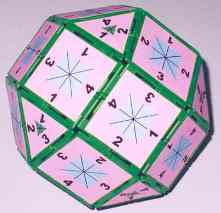
The dodecahedron (2) puzzle
This puzzle has 6 natural solutions and 2 equivalence classes that can be distinguished in the following form. Consider two opposite dodecahedron edges. There are other four that are orthogonal to these two. The six edges are over the faces of a virtual cube where the dodecahedron is inscribed. There are five such cubes. The first equivalence class (with only one element / natural solution, see Symmetry / Simetria (9)) has the same number associated to the edges that belong to the faces of each cube. The second equivalence class (with five elements / natural solutions) has the same number associated to the edges that belong to the faces of one of the fives cubes.
The first class group is of order 120 and the second class group is of order 24.
In this first photo: the right hand side is obtained from the left hand side using the permutation (123) of the numbers
In this second photo: the right hand side is obtained from the left hand side using the permutation (25)(34) of the numbers
In this third photo: the right hand side is obtained from the left hand side using the permutation (12354) of the numbers
In this fourth photo: the right hand side is obtained from the left hand side using the permutation (12345) of the numbers
In this fifth photo: the right hand side is obtained from the left hand side using the permutation (123) of the numbers
In each of these photos one can see two of the six natural solutions of the dodecahedron (2) puzzle. These solutions are easily recognized because they have the number 2 (solution in the l.h.s.) and the number 3 (solution in the r.h.s) assigned to orthogonal edges.

Wednesday, March 10, 2010

Symmetry / Simetria (9)

In this first photo: the right hand side is obtained from the left hand side using the identity permutation of the numbers
In this second photo: the right hand side is obtained from the left hand side using the permutation (25)(34) of the numbers
In this third photo: the right hand side is obtained from the left hand side using the permutation (13)(24) of the numbers
In this fourth photo: the right hand side is obtained from the left hand side using the permutation (354) of the numbers
Dodecahedron (2) puzzle
In each of these photos one can see one of the six natural solutions of the dodecahedron (2) puzzle. This solution is easily recognized because it has the same numbers assigned to orthogonal edges. It is symmetric by a reflection or a central symmetry (here colours do not matter, only numbers matter). This is a symmetry of this solution. This symmetry belongs to the group of this solution. If you exchange (an even permutation) of the numbers you obtain the same natural solution that belongs also to its group. It is the icosahedron's group and it has 120 elements. We just saw a simple way of showing an isomorphism between the icosahedron/dodecahedron's group and the group generated by the reflections and the even permutations of {1,2,3,4,5}: {-1,1}xA5.