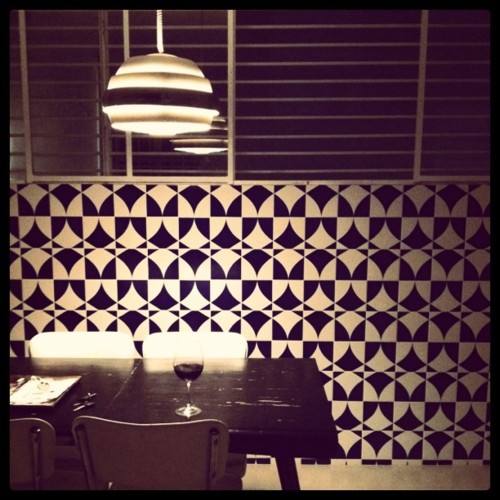
Showing posts with label colour symmetry. Show all posts

Saturday, July 28, 2012

Colour symmetry. Alexandre Mancini, Brasil - p2mg - «p2mm»

Numbers mean rotations of order 2. Mirrors are represented by red lines and and glides by green ones. 


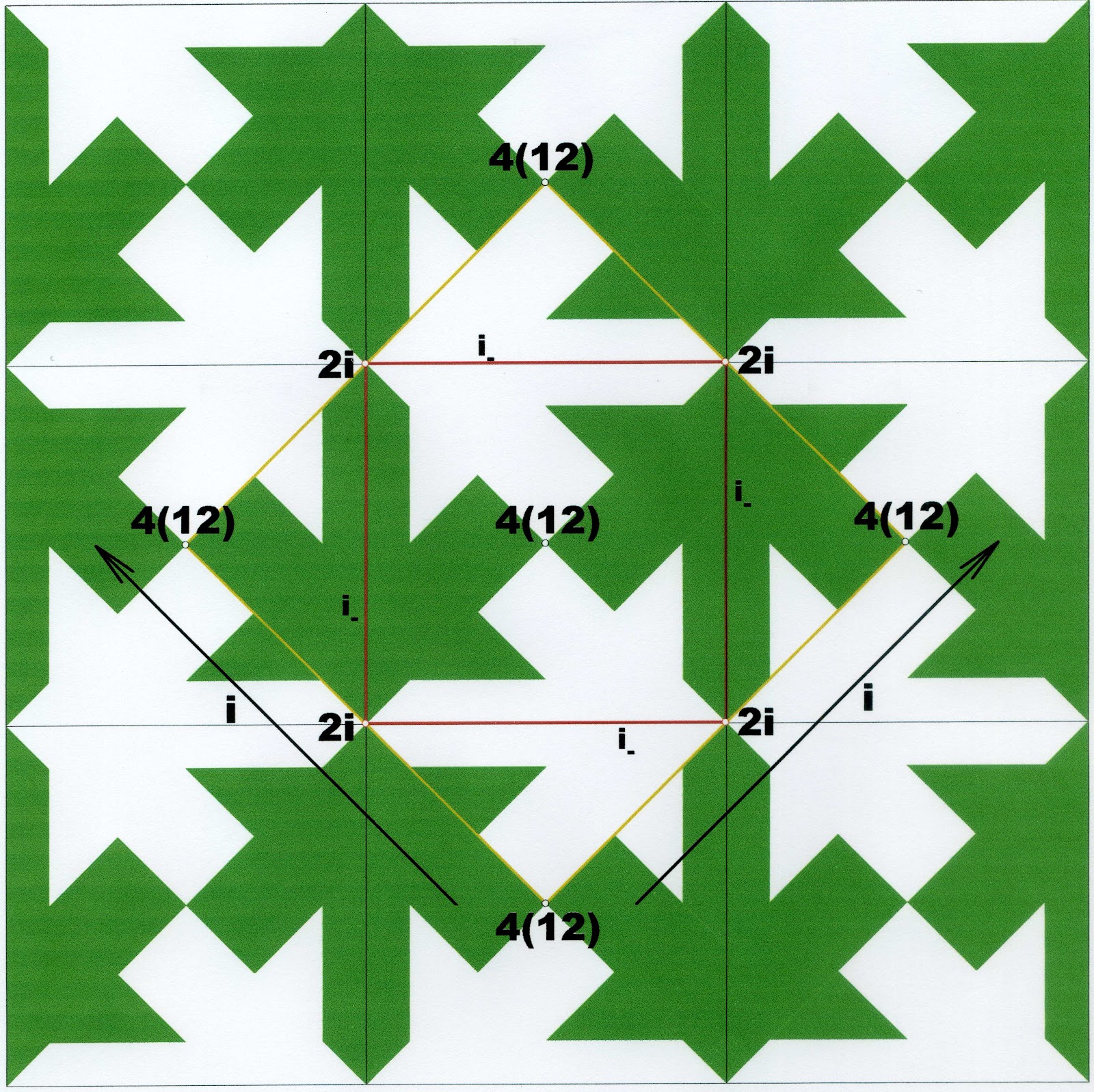
Colour symmetry in the same pattern. Reflections are represented by red lines. (12), means that the colours blue and white interchange; i means the identity.

This is an example of the case stated in the fourth row of the table in Section 4.4 (Figure 12, «p2mm») in
-  
See the same case in

Saturday, May 12, 2012

Colour symmetry. Portuguese pavements: Adro da Igreja do Senhor Bom Jesus de Matosinhos (Igreja Matriz) - p2gg - «p2mg»


Small circles mean rotations of order 2. Mirrors are represented by red lines, glide reflections by green lines. Yellow lines are the border of a fundamental region. (12) means that the colours white and grey are interchanged; i means the identity.

This is an example of the case stated in the fourth row of the table in Section 4.5 (Figure 13, «p2mg») in

See:
Wallpaper groups. Portuguese pavements: Adro da Igreja do Senhor Bom Jesus de Matosinhos (Igreja Matriz) - p2gg
O Nasoni era italianíssimo, mas soube entender os méritos do granito lusitano...

Saturday, April 21, 2012

Colour symmetry. Portuguese tiles: Homero Gonçalves - p2 - «p2»


Colour symmetry in the same pattern. Yellow lines are the border of a fundamental region. 2(12) and 2i mean rotations of order 2. (12) means that the colours white and brown are interchanged; i means the identity.

This is an example of the case stated in the  third row of the table in Section 4.1 (Figure 11, «p2») in
Imagens copiadas da página 27 de

Monday, April 16, 2012

Colour symmetry. Tiles: Athos Bulcão, Brasília Palace Hotel - p2mg - «p2mm»


Colour symmetry. 2(12) and 2i mean rotations of order 2. (12) means that the colours white and blue are interchanged; i means the identity. Mirrors are represented by red lines.

This is an example of the case stated in the  fourth row of the table in Section 4.4 (Figure 12, «p2mm») in

See:
Wallpaper groups. Tiles: Brasil, Brasilia Palace Hotel - p2mg

Wednesday, April 11, 2012

Colour symmetry. Guilherme Mendes da Rocha, Brasil - p1 - «pg»

Author: Guilherme Mendes da Rocha, Arquiteto

Colour symmetry in the same pattern. Yellow lines are the border of a fundamental region. Glides are represented by green lines.  (12), (34) and (56) means that the colours interchange; i means the identity.
Colours:
1- Pink Madder Lake; 2 - Cyan; 3 - Sepia; 4 - Deep Cobalt; 5 - Peacock Blue; 6 - Light Geranium Red.

This is an example of three superpositions, (12), (34) and (56), in the case stated in the third row of the table in Section 4.3 (Figure 12, «pg») in

Sunday, April 08, 2012

Colour symmetry. Portuguese tiles: Homero Gonçalves - p1 - «p2»


Colour symmetry in the same pattern. Yellow lines are the border of a fundamental region. 2(12) and 2i mean rotations of order 2. (12) means that the colours white and brown are interchanged; i means the identity.

This is an example of the case stated in the  fourth row of the table in Section 4.1 (Figure 11, «p2») in
Imagens copiadas da página 27 de

Thursday, March 29, 2012

Colour symmetry. Portuguese pavements: Mar largo / Portuguese pavement wave - p2mg - «p2mg»


Small circles mean rotations of order 2. Mirrors are represented by red lines and and glides by green ones. Yellow lines are the border of a fundamental region.


Small circles mean rotations of order 2. Mirrors are represented by red lines, glide reflections by green lines. Yellow lines are the border of a fundamental region. (12) means that the colours white and grey are interchanged; i means the identity.

This is an example of the case stated in the third row of the table in Section 4.5 (Figure 12, «p2mg») in
Lisbon, «Rossio» - p2mg

-
Mar Azul (Cesária Évora)
Mar azul (Cesária Évora, Marisa Monte)
Texto: Mar Azul (B. Leza (Francisco Xavier da Cruz))
Sobre B. Leza (03 de Dezembro de 1905 - 14 de Junho de 1958):
‘B. Leza contód de nôs móda’

Friday, March 23, 2012

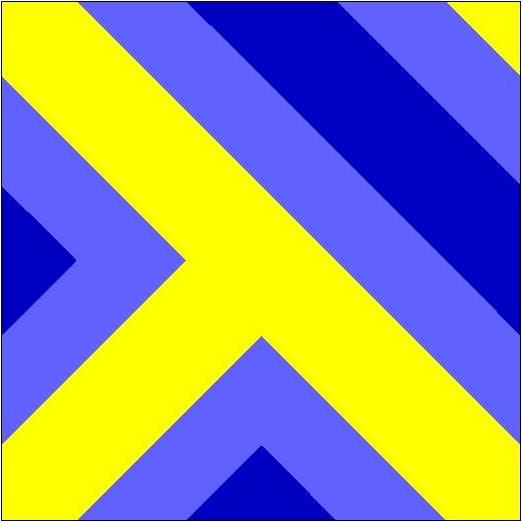
Colour symmetry. Tiles: Portugal, Palácio Nacional de Sintra / The National Palace of Sintra - c2mm - «p4gm»


Colour symmetry in the same pattern. Yellow lines are the border of a fundamental region. Small circles mean rotations; numbers mean rotations of order 2 and 4. Mirrors are represented by red lines. Glide reflections are not represented. (12) means that the colours white and green are interchanged; i means the identity.

This is an example of the case stated in the fourth row of the table in Section 4.11 (Figure 15, «p4gm») in

See
Wallpaper groups. Tiles: Portugal, Palácio Nacional de Sintra - c2mm
Azulejos do Palácio Nacional de Sintra / Sintra National Palace Tiles

Saturday, March 17, 2012

Colour symmetry. Portuguese pavements: Lisboa, Praça do Município, Eduardo Nery - p4mm - «p4mm»

Versão da minha exclusiva responsabilidade, feita para este blogue, de uma parte (expandida no desenho) do pavimento da Praça do Município, de Lisboa, cujo autor é Eduardo Nery. Esta versão destina-se apenas a mostrar as propriedades geométricas dessa parte do pavimento.


Numbers mean rotations of order 2 and 4. Mirrors are represented by red lines. Glide reflections are not represented.


Colour symmetry in the same pattern. Small circles mean rotations; numbers mean rotations of order 2 and 4. Mirrors are represented by red lines. Glide reflections are not represented. (12) means that the colours white and grey are interchanged; i means the identity.

This is an example of the case stated in the fourth row of the table in Section 4.10 (Figure 14, «p4mm») in

Eduardo Nery
Image scanned from the book
See:
Eduardo Nery (Official Website)
(in this blog)

Sunday, March 11, 2012

Colour symmetry. Portuguese pavements: Brasil, Londrina and Ipanema, Calçadão - p2mm - «c2mm»


«» are all drawn by Jorge Rezende


Small yellow circles mean rotations of order 2. Mirrors are represented by red lines.

Mirrors are represented by red lines, glide reflections by green lines. Small yellow circles mean rotations of order 2. Yellow lines are the border of a fundamental region. (12) means that the colours white and grey are interchanged; i means the identity.


This is an example of the case stated in the third row of the table in Section 4.8 (Figure 13, «c2mm») in


The pavement in Ipanema is similar:


See:
Wallpaper groups. Portuguese pavements: Brasil, Londrina, Calçadão - p2mm
Wallpaper groups. Portuguese pavements: p2mm
Wallpaper groups. Portuguese pavements: Ipanema, Calçadão - p2mm
"Num tempo / página infeliz de nossa história..."

(Vinícius de Moraes / Tom Jobim)

Tuesday, March 06, 2012

Colour symmetry. Pavements: Brasil, S. Paulo - p2 - «p2»

Small yellow circles mean rotations of order 2. Yellow lines are the border of a fundamental region.

Small yellow circles mean rotations of order 2. Yellow lines are the border of a fundamental region. (12) means that the colours white and grey are interchanged; i means the identity.

This is an example of the case stated in the third row of the table in Section 4.1 (Figure 11, «p2») in

See:
Wallpaper groups. Pavements: Brasil, S. Paulo - p2
Wallpaper groups. Pavements: p2

Saturday, March 03, 2012

Colour symmetry. Portuguese pavements: Funchal, Praça do Município - pm - «cm»

Mirrors are represented by red lines. Yellow lines are the border of a fundamental region.
Mirrors are represented by red lines, glide reflections by green lines. Yellow lines are the border of a fundamental region. (12) means that the colours white and grey are interchanged; i means the identity.

This is an example of the case stated in the second row of the table in Section 4.7 (Figure 13, «cm») in


See:
Wallpaper groups. Portuguese pavements: Funchal, Praça do Município - pm
Wallpaper groups. Portuguese pavements: pm